

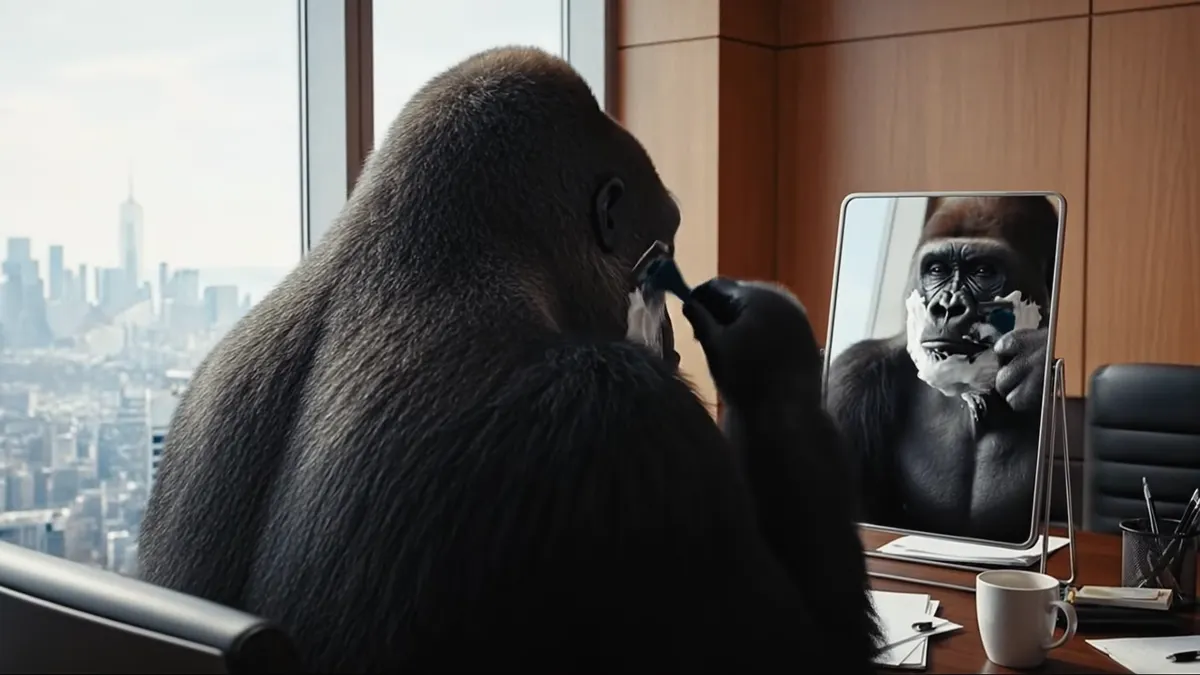
Dollar Shave Club (DSC) is once again taking aim at established razor brands, but this time with a twist: its first AI-generated advertisement uses the very technology it employs as the punchline. Developed in partnership with creative boutique Too Short For Modeling, the new campaign, titled "We Put Our Money Where It Matters," leverages generative AI to create complex visuals while maintaining a rapid development timeline of just a few weeks.
The 60-second spot humorously depicts a boardroom meeting at a fictional rival, "Razor Corp." Following the introduction of Dollar Shave Club's "best razor ever," the rival company's leadership scrambles for cost-cutting measures. Ideas ranging from selling a private jet to firing an in-office DJ are quickly dismissed, leading the tone-deaf CEO to propose the ultimate efficiency hack: replacing employees with artificial intelligence.
The Campaign's Strategy and Context
This latest marketing push reinforces Dollar Shave Club's long-standing irreverent brand positioning, which has consistently needled legacy consumer packaged goods (CPG) rivals. The brand first gained widespread attention in the early 2010s with edgy, viral ads that were produced on a shoestring budget and directly challenged competitors like Gillette. Now, DSC is adapting this successful approach for the modern AI era.
The campaign arrives at a time when consumer sentiment towards AI-generated creative content remains divided. Recent examples highlight this tension: McDonald's Netherlands recently pulled an online video that used AI to illustrate holiday stresses after facing significant backlash. Similarly, Coca-Cola's AI-fueled seasonal campaigns continue to spark heated discussions, with critics often citing a lack of human warmth. Even vodka maker Svedka plans to test audience appetites for generative AI with a largely AI-created Super Bowl commercial in February.
By making the CEO's misguided suggestion to replace staff with AI the central joke, Dollar Shave Club provides itself a clever layer of protection. The brand aims for the effort to be "meme-worthy," emphasizing that capturing consumer attention is paramount in today's crowded market.
Dollar Shave Club has intensified its marketing efforts this year to stand out in a highly competitive category. Beyond traditional razor giants like Gillette and Schick, the brand also contends with a growing fleet of fellow direct-to-consumer (DTC) disruptors. In September, DSC launched its largest campaign to date to promote two new razor offerings. Interestingly, that initiative took a contrasting approach to the AI concept, focusing on real Dollar Shave Club members who formed the "Order of the Blade" – an unconventional in-house agency that workshopped ideas for billboards and TV commercials.
The trajectory of Dollar Shave Club mirrors the broader journey of DTC brands over the past decade. After a rapid ascent fueled by early e-commerce and subscription booms, Unilever acquired Dollar Shave Club for $1 billion in 2016. This deal was initially seen as a potential game-changer for legacy CPGs, though Unilever later sold the grooming brand to private equity in 2023.


