

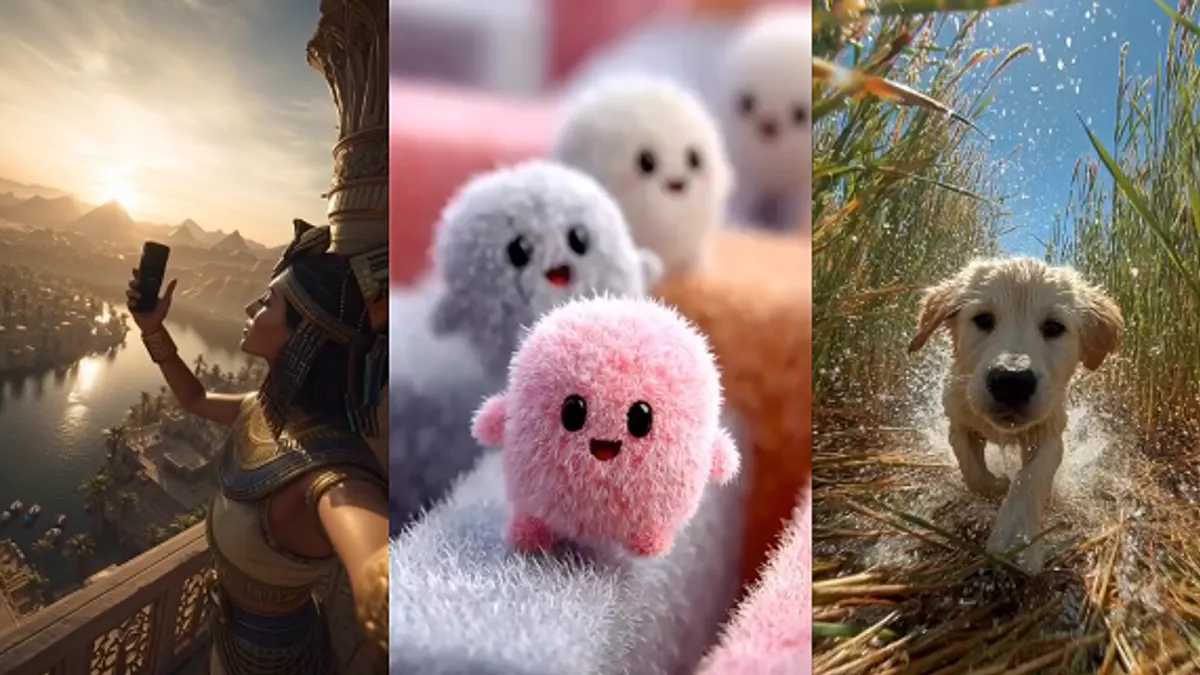
Meta's ambitious push into generative AI faces a significant hurdle: sustained user engagement. Despite integrating AI tools across its vast ecosystem, internal data suggests that the dedicated 'Vibes' AI-generated video feed is struggling to retain user attention beyond initial curiosity.
Meta has frequently touted its Meta AI chatbot as the world's most used AI assistant, boasting nearly 500 million users. However, this figure is largely skewed by its deep integration into the search functions of all Meta apps, meaning many users interact with it incidentally rather than intentionally seeking out AI tools. With 3.54 billion daily active users across its platforms, a significant portion of these "AI users" may not be actively engaging with Meta's AI offerings.
A more telling indicator of genuine interest lies in the usage of Meta's standalone Meta AI app. Launched in April through a rebranding of its "Meta View" app, it initially offered limited functionality without Meta AI glasses. While the app saw a notable surge in popularity, particularly in late September, this spike coincided with the introduction of the 'Vibes' AI-generated video content feed.
The launch of 'Vibes' at the end of September prompted a significant increase in app downloads, with Similarweb reporting 8.8 million downloads in October and around 30 million monthly active users. However, this initial rush appears to be driven by curiosity rather than sustained engagement.
Internal Data Reveals Retention Challenges for 'Vibes'
Recent internal Meta data, obtained by Business Insider, paints a clearer picture of 'Vibes' retention challenges:
- The 'Vibes' feed currently has approximately 2 million daily active users (DAU), showing a slight week-over-week decline. This contrasts sharply with the 30 million monthly active users reported in October, suggesting a significant drop-off after initial use. (For context, social media apps typically see DAU figures around half of their monthly active users).
- In early November, the majority of 'Vibes' growth stemmed from India (702k DAU) and Brazil (114k DAU).
- Following its European launch on November 6th, 'Vibes' recorded 23k DAU in the region.
- Usage has declined in parts of Southeast Asia, with the Philippines experiencing a 9% drop in DAU and Thailand a 7% decline.
This data indicates that while 'Vibes' garners some interest, its ability to hold audience attention is relatively low compared to initial downloads and surges. This suggests that a feed composed solely of AI-generated clips may not be compelling enough for long-term engagement.
The Broader Implications for Meta's Generative AI Strategy
The article observes that much of this content could be categorized as "AI slop"—derivative and uninspired—lacking the intrinsic interest or entertainment value to captivate users. This raises questions about the broader implications for Meta's substantial investment in generative AI, as the company aggressively integrates AI prompts into nearly every feature of its apps.
While AI tools offer new creative avenues, human ideas and unique perspectives remain central to creativity and the essence of social networks. The article questions whether users genuinely desire AI-generated images of themselves in fantastical scenarios or short videos of non-existent things, especially when these often lack a compelling concept or skilled prompting.
The article posits that AI reply prompts and post suggestions often feel "cold and empty" or "pointless" because social media thrives on genuine human connection and the sharing of individual thoughts. Relying on AI to guide these interactions risks transforming social platforms into spaces where "bots talk to more bots," simulating engagement rather than fostering it.
This perspective aligns with former Meta AI chief Yann LeCun's view, who has described current large language model (LLM) development as "largely a dead-end" for meaningful societal advancement. The article further argues that LLMs, being sophisticated pattern-matching prediction systems rather than truly "intelligent" entities, may not contribute significantly to the social media format, which fundamentally relies on authentic human expression.


