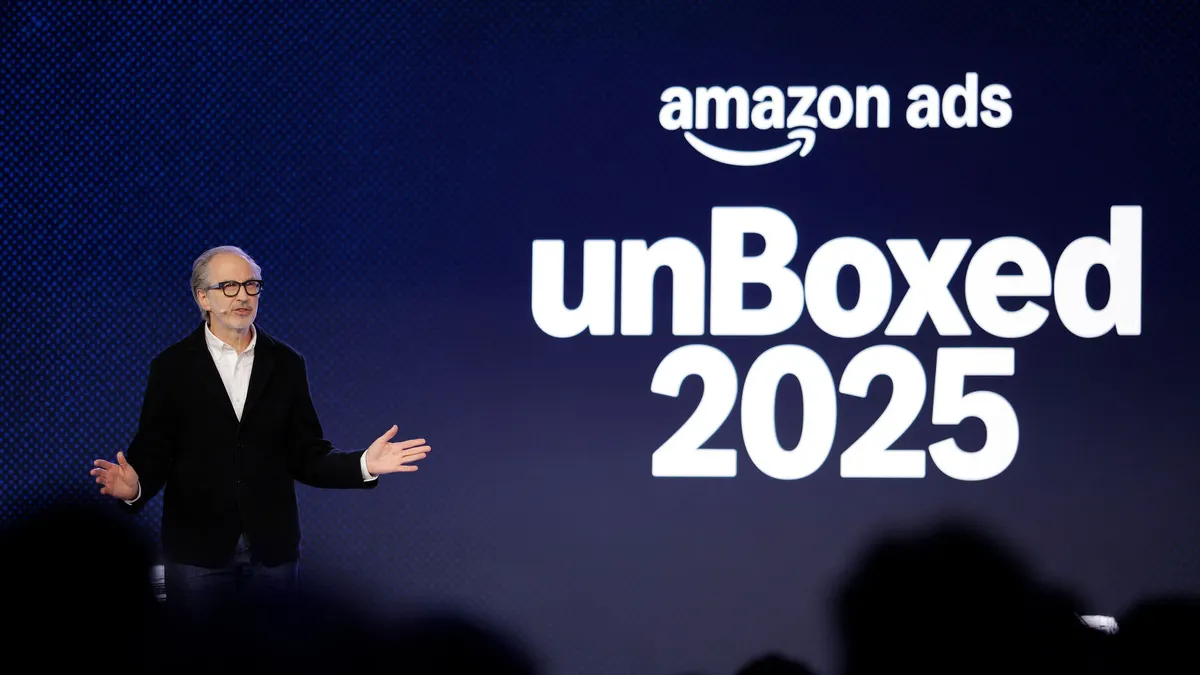
What a difference a year makes for Amazon's advertising business. After experiencing a slowdown in ad sales growth in Q3 2024, the company's ad revenue has seen a significant acceleration, hitting 24% year-over-year growth in Q3 2025, with quarterly revenue nearing $18 billion. This resurgence set the stage for Amazon's UnBoxed 2025 conference in Nashville, where the tech giant unveiled a suite of AI-powered tools and capabilities designed to fundamentally transform how marketers and agencies operate.
Central to Amazon's ambitious vision is the creation of a unified, AI-driven ad hub. The company introduced full-funnel campaigns and a revamped Campaign Manager, integrating sponsored ads and its demand-side platform (DSP) into a single, cohesive ecosystem. This move, alongside a strengthened focus on streaming TV advertising, aims to simplify and centralize ad buying.
"We're doing more than just building tools," stated Kelly MacLean, Vice President of Engineering, Science, and Product for Amazon Ads. "We're building a one-stop shop, empowering you to make smarter decisions to drive better results across the entire advertising journey."
AI at the Core of New Advertising Solutions
Launching next year, the new full-funnel campaigns offering is an agentic AI tool designed to automate campaigns across sponsored ads, display ads, and streaming TV. This solution leverages Amazon's extensive first-party data and an Authenticated Graph that reportedly reaches 90% of all U.S. households.
"Full-funnel campaigns are the simplest way to grow brand awareness, attract new customers, and drive conversions," said Paul Kotas, Senior Vice President of Amazon Ads. "It's early, but we're super excited about what's possible when you combine Amazon Ads' unmatched supply and signals with the capabilities of AI."
Powering these full-funnel campaigns is Ads Agent, an AI agent that streamlines campaign planning, launch, and optimization by automating time-intensive tasks such as targeting, media planning, and data analysis. AI also underpins Creative Agent, a previously announced creative tool that now supports streaming TV ad creation, and the enhanced Campaign Manager, signaling a broader shift in digital advertising.
Ted Iobst, President of performance marketing agency Stellar, noted this industry shift: "Platforms are automating the low-value, executional work of campaign setup, bidding, and optimization, which means agencies can no longer differentiate on operational efficiency alone. The winners will be the firms that move up-funnel—into strategy, creative intelligence, cross-channel orchestration, and real measurement."
Beyond efficiency, Amazon is also harnessing AI to drive tangible outcomes for marketers facing tighter budgets. The company has upgraded its Brand+ and Performance+ tools with advanced AI models and new consideration tactics. For instance, H&R Block successfully combined its data with Amazon's during tax season, creating seed audiences for retargeting. This strategy led to a 144% lift in full-funnel conversion rate and a 35% improvement in cost per acquisition, according to MacLean.
Amazon's Dominance in Streaming TV Advertising
Amazon's rise as an advertising powerhouse is closely tied to the growth of Prime Video as an ad-supported streaming platform. At UnBoxed, Amazon announced that Prime Video now boasts an average monthly ad-supported reach of over 315 million global viewers, a significant increase from 200 million in April 2024.
The company has also been actively integrating other publishers into its platform, positioning itself as the sole destination for advertisers to access all premium streaming TV and audio inventory. The newly introduced Inventory Hub allows advertisers to negotiate both standard streaming TV deals and those with premium publishers. Furthermore, Complete TV, a previously announced tool for planning, managing, and optimizing streaming TV investments, is now universally available.
"Thanks to our signals, powered by AI, you can easily manage and meet all your upfront commitments across every publisher," MacLean explained. "You can incorporate your linear TV data to see the full picture across linear and streaming TV reach for a complete view of audience overlap. You won't find this combination of intelligence, flexibility, and privacy anywhere else in the industry."
Amazon's intensified focus on streaming TV comes as the channel now accounts for over 44% of total TV viewing time in the U.S., surpassing broadcast and cable combined, according to Nielsen data. The shift towards programmatic selling in streaming TV is also evident, with 30% of non-YouTube streaming sold programmatically, and 80% of that activated through biddable deals, as cited by Lauren Bernard, a Principal Technical Product Manager for Amazon Ads, at UnBoxed.
Bernard acknowledged the potential of programmatic to drive business outcomes but also highlighted ongoing challenges. "The shift to programmatic is laying the groundwork for a world where advertisers have more flexibility, optimization levers, and control, forecasting a future where streaming TV is used to drive actual business outcomes," she said, while admitting that framing streaming TV as a performance channel was "a bit generous." She added, "There's a reason that 30% and not 100% of streaming TV ads are sold programmatically today. Operating in the new world, it's tough, and our work is not yet done to resolve advertisers' pain points."
Driving Measurable Outcomes with Integrated Solutions
Amazon is actively addressing the persistent issues of fragmentation, inefficiency, and complexity within streaming TV advertising. Through its publisher deals in its DSP, campaigns leveraging Amazon's holistic streaming TV solutions have shown 1.4 times higher incremental reach, 45% higher detail page view rates, and 26% better purchase rates. Strategic partnerships, such as its deal with Roku, have improved efficiency, leading to 42% higher unique reach at the same budget, 26% less frequency per user, and a three-times return on ad spend in early testing.
To simplify streaming TV investments, Amazon has developed tools like Complete TV and full-funnel measurement, which integrate insights from Amazon Marketing Cloud with data from third-party vendors including Nielsen, VideoAmp, Samba TV, and Circana.
Case studies presented at UnBoxed underscore these capabilities. A Lay's campaign, for example, consolidated Prime Video with streaming TV apps across the open internet via Amazon DSP. By leveraging Amazon Marketing Cloud and frequency management, the campaign achieved 133% higher purchase rates, 79% higher incremental reach, and a 9% lift in brand awareness, while also saving 3% of the media budget through reduced platform fees.
Appliance company SharkNinja also saw significant results for its Ninja Crispi air fryer. Dave Kersey, the company's Global Head of Media, explained that applying authenticated reach through Amazon DSP led to a 30% reduction in cost per weekly household reach and a 12% reduction in CPM.
"We needed to have precision in the marketplace, and we needed to make sure that all of our dollars are being spent as effectively as possible," Kersey stated. "[The results] prove that our model of looking at the right layers of signals, as well as working within the right DSPs and the right partners, can give us that efficiency, but also that incredible business impact, as well."