The Hershey Company is ushering its iconic holiday advertising into the modern era, transforming its beloved 1989 "Holiday Bells" commercial into an interactive, multichannel experience. Moving beyond traditional ad placements, the snack giant has launched a comprehensive campaign centered around a physical activation at New York City's Rockefeller Center, complemented by extensive digital and social media engagement.
“We saw an opportunity to bring back what I would argue is really the commercial that signals it's the holiday season, maybe outside of Coca-Cola,” stated Vinny Rinaldi, Hershey's vice president of consumer connections. He emphasized the company's approach, noting, “The one difference is we have not AI generated our assets just yet.” This stance contrasts with some controversial tactics adopted by competitors, such as Coca-Cola's use of AI in its Santa Claus ads.
Instead, Hershey has chosen to pair the familiar red, green, and silver Hershey's Kisses from its long-running "Holiday Bells" spot with another iconic seasonal tradition: the lighting of the Christmas tree at Rockefeller Center. As part of this initiative, Hershey sponsored the “Christmas in Rockefeller Center” special that aired on December 3rd, launching a campaign designed to modernize the cherished commercial without diluting its enduring charm.
“The simplicity of the spot — no dialogue, no celebrities, just animated Hershey's Kisses — is key to its enduring charm,” said Stacy Taffet, chief growth officer at Hershey, in a statement. “It has become one of the most iconic holiday advertisements in American marketing history.”
The 15-second "Holiday Bells" ad, born from a spontaneous idea during a 1989 campaign shoot by former brand manager John Dunn and directed by Carl Willat, uses stop-motion animation to depict Hershey's Kisses playing “We Wish You a Merry Christmas.” The commercial, which marked its annual return to airwaves during the December 3rd special, remains Hershey's longest-running advertisement.
“We've always talked about how to modernize the bells,” Rinaldi explained. “Why would we touch it? Why do you have to modernize it when it's been such a long standing opportunity that's been on air? When you bring a 360-degree view of this, not everybody's watching just the TV commercial.”
Ringing in the Holidays with Interactive Experiences
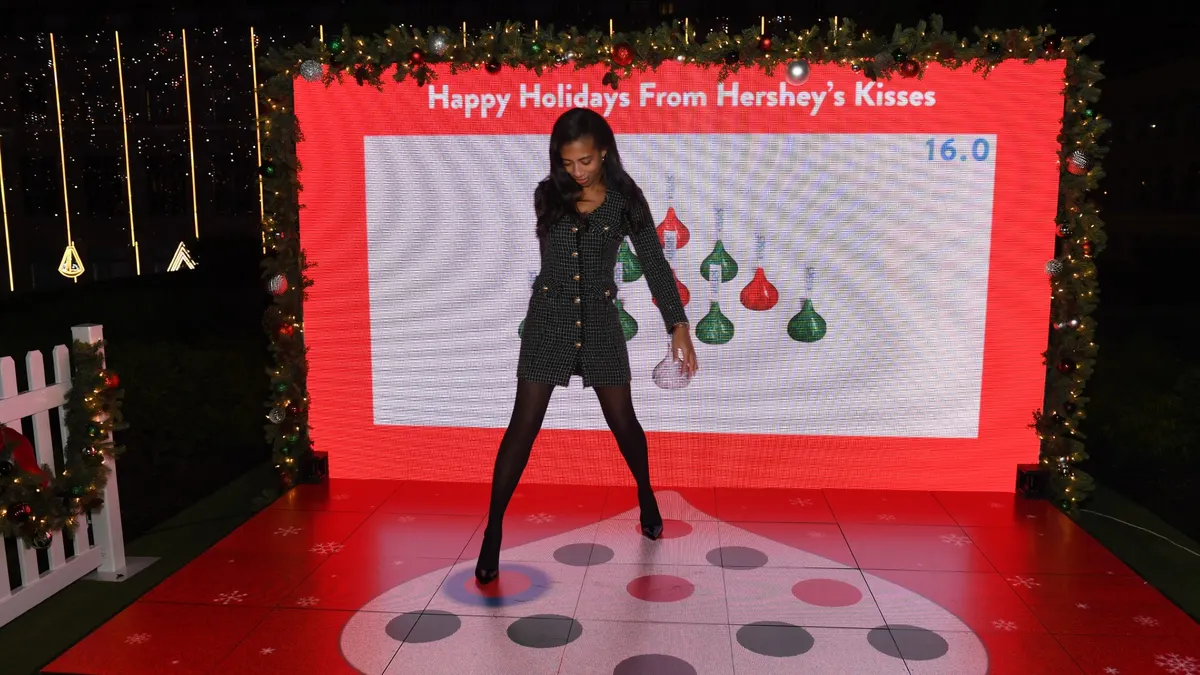
Central to Hershey's holiday strategy is an interactive experience at Rockefeller Center, inviting consumers to recreate the "Holiday Bells" ad on an LED-powered mat. This engaging activation, described as a blend between the oversized keyboard from the movie “Big” and the gameplay of “Dance Dance Revolution,” ran through December 7th during one of the busiest weekends at the plaza.
“People will have an opportunity to engage, to capture their own content, to share and post,” Rinaldi noted. “You've got this incredible asset that everybody knows is Hershey Kisses and Christmas, so what better way again than to bring that to life across all of our digital platforms, social media and music?”
Beyond the physical experience, Hershey's multichannel campaign includes collaborations with local influencers, branded effects on TikTok and Snapchat, a SiriusXM home screen integration, a rewards-based integration in Candy Crush, and a music video featuring country music star Lainey Wilson.
This holiday campaign exemplifies Hershey's evolving content strategy. While the adage “content is king” holds true, its application is shifting as consumer preferences evolve across video, audio, and social media. “We've done a lot of testing in this area with different creative iterations over the last few years,” Rinaldi said. “Whether it's time spent with people, product or actual long-form content, what really rises to the top is where we're continually honing in our creative ecosystem.”
The interactive experience underscores a strategic shift from hyper-targeted digital marketing back to impactful, broad-reaching ideas. This approach aims to connect with consumers across diverse demographics and channels, from children stepping onto the musical mat in Rockefeller Center to individuals engaging with digital content and activations.
Connecting with Consumers in a New Era
Rinaldi, who assumed his new role as vice president of consumer connections in October, is instrumental in driving this content strategy. He now oversees integrated media and strategy, creative studio and channel experiences, marketing intelligence and enablement, and other marketing functions. His focus is on transforming disparate consumer touchpoints into a cohesive, connected ecosystem.
“The way you show up in a TV asset, all the way through to the packaging that will sit on your shelf, should be completely connected and should resonate with one another,” he asserted. “As a consumer, there should never feel like there's a disconnect on what you're experiencing with any of our brands.”
Achieving this seamless connection requires Hershey to rethink its communication strategies and impact measurement, especially as consumer behaviors continue to evolve with trends like shoppable commerce and dual screening.
“That's a really big shift in not just our organization, but the industry in general, having [those functions] reside together to make sure that we are thinking about each touchpoint as we build our assets,” Rinaldi explained. “The visual identity systems our brand shelf has, the content and packaging that goes onto a digital shelf, the assets you're spending time with on a TV screen, a mobile screen or a screen that's on the gas station — all of these things play a role in a consumer's life.”