Google's Performance Max (PMax) campaigns, much like the upper-funnel Demand Gen, represent a significant departure from traditional Google Ads campaign types. While the underlying search behavior and core marketing principles remain constant, PMax necessitates a distinct approach. Typically, PMax isn't the first campaign launched in an account, often layered on after establishing Search and/or Shopping campaigns for testing and scaling. However, when the time comes to leverage its power, a specific, modern mindset is crucial. Relying on Google Ads methods from 2015 will simply not yield success in today's automated landscape.
To truly excel with Performance Max, marketers must tailor their approach and embrace a new mentality.
Understanding the Core Principles of Performance Max
A robust mindset for modern PPC begins with fundamental knowledge. If the core differences between Performance Max and legacy campaign types (like Search and Shopping) aren't clear, that's the first step. In essence, Performance Max is algorithm-driven, not input or control-driven. It requires a degree of relinquishing direct control, as attempting to micro-manage where control doesn't exist will only lead to wasted ad spend. Trying to force PMax into traditional campaign structures will stifle the algorithm, resulting in poor-quality conversions and teaching the system to pursue more of the same.
Here are five fundamental truths to keep in mind when working with Performance Max:
- Limited Targeting Control: Performance Max won't strictly adhere to your targeting instructions. While you can provide initial direction via audience signals, the system will ultimately make its own decisions regarding channels and audiences. Even keywords serve more as guidance than strict rules.
- Automated Creative Combinations: You'll still provide all ad components—responsive search ads, video and static creatives, and robust product feeds. However, Google's system will test and combine these elements with various audiences to determine the most effective pairings, rather than you dictating them.
- Reduced Visibility: Achieving strong results with Performance Max often means accepting less granular visibility into specific queries or placements. While this might be uncomfortable, the campaign thrives when you set it up correctly and trust the system, albeit with ongoing supervision and verification of its output.
- Data Reigns Supreme: Performance Max is inherently data-driven. Google expects extensive data inputs, and accounts with more conversion data will perform better. Clearer first-party inputs, robust audience signals, and comprehensive product feeds significantly improve the system's ability to deliver desired conversions and accelerate the learning phase.
- Evolving Reporting: While PMax reporting has improved significantly, offering access to asset group reports, search terms, and negative keywords, it's still not perfect. Marketers should make peace with the fact that full transparency isn't always available, and attribution can be more complex than usual.
Fortunately, marketers retain control over broader marketing principles and strategic direction, which are crucial for PMax success:
- Positioning, offer, and messaging strategy.
- Quality and depth of your product feed.
- Strength of your audience signals.
- Depth of your first-party data inputs (e.g., conversion tracking, customer lists, data feeds).
- Relevance of your ad copy, creatives, and landing pages.
- Bidding strategy and goals.
- High-level campaign and asset group structure.

Screenshot from X (Twitter), November 2025
Read more: Should Advertisers Rethink The ‘For Vs. Against’ Stance On Performance Max?
Traits of PPC Managers Who Struggle with Performance Max
Many PPC managers find it challenging to adapt to Google's machine learning advancements, often complaining about aspects of automation. While traditional Search and Shopping campaigns remain viable, applying an outdated mindset to Performance Max and expecting results is a recipe for failure. Several common behaviors indicate a struggle with PMax:
- Demanding Granular Control: A desire to dictate every system operation, deploy exact match keywords, complex manual bidding, and specific traffic sculpting techniques signals a distrust of machine learning.
- Over-reliance on Past Experience: Believing past success guarantees future results without staying updated on market and technological developments. These "old school" marketers may feel entitled to success due to tenure, rather than continuous learning.
- Narrow Specialization: Focusing solely on Google Ads account management. Modern PPC demands a broader skill set, including copywriting, landing page optimization, conversion rate optimization, product feed management, market research, and offer positioning.
- Lack of Patience and Trust: Lacking the "diamond hands" to trust their strategy. Reacting to early, below-average results by making frequent changes resets the learning period, delaying the system's ability to deliver good conversions. PMax often requires 3-6 weeks to stabilize.
- "Set It and Forget It" Automation: Adopting a passive approach to automation. While PMax is automated, it still requires monitoring early results and providing data inputs to guide the system towards desired outcomes.
- Expecting Magic from the System: Failing to persuade clients to provide essential first-party data. Without clear inputs on what success looks like, Google will make educated guesses, which is particularly challenging for lead-gen businesses like plumbers or contractors.
Some industries, such as pharmaceuticals or legal services, require a higher level of granular control due to regulatory mandates or insufficient search volume for Google's algorithms to make informed decisions. These niches may not be ideal for a fully automated PMax approach compared to mass-market verticals like apparel.
The PPC Manager Who Wins with Performance Max
While algorithmic campaigns aren't suitable for every account, when an opportunity arises to scale with Performance Max, a specific type of marketer excels:
- Strategic Focus: They understand where their expertise is most valuable, handing over ad operations control to the system. This allows them to concentrate on areas where human creativity and strategy are irreplaceable: creative development, ad copy, landing page UX, data sourcing, and interpretation.
- Commitment to Continuous Learning: They recognize that past campaign success doesn't guarantee future results. Winning marketers are eager to learn and adapt with every new project and iteration, treating each PMax campaign as a unique learning opportunity.
- Data-Driven Acumen: They grasp the immense value of data and know how to source it effectively. By building an ecosystem of data inputs and insights, they provide Google with more information, leading to better PMax results. They are skilled at convincing clients of the critical importance of data sharing.
- Strategic Patience: They possess the patience and confidence to stick to a well-defined plan, especially during the initial learning phase. Rather than making impulsive changes when early results are poor, they allow the system time to optimize and reach its full potential.
- Exceptional Client Communication: They excel at managing client expectations and fostering collaboration. They can identify when PMax might not be the best fit (e.g., for lead-gen clients unwilling to share CRM data) and recommend alternative strategies like traditional Search. Proactive communication throughout the campaign lifecycle is a hallmark of their approach.
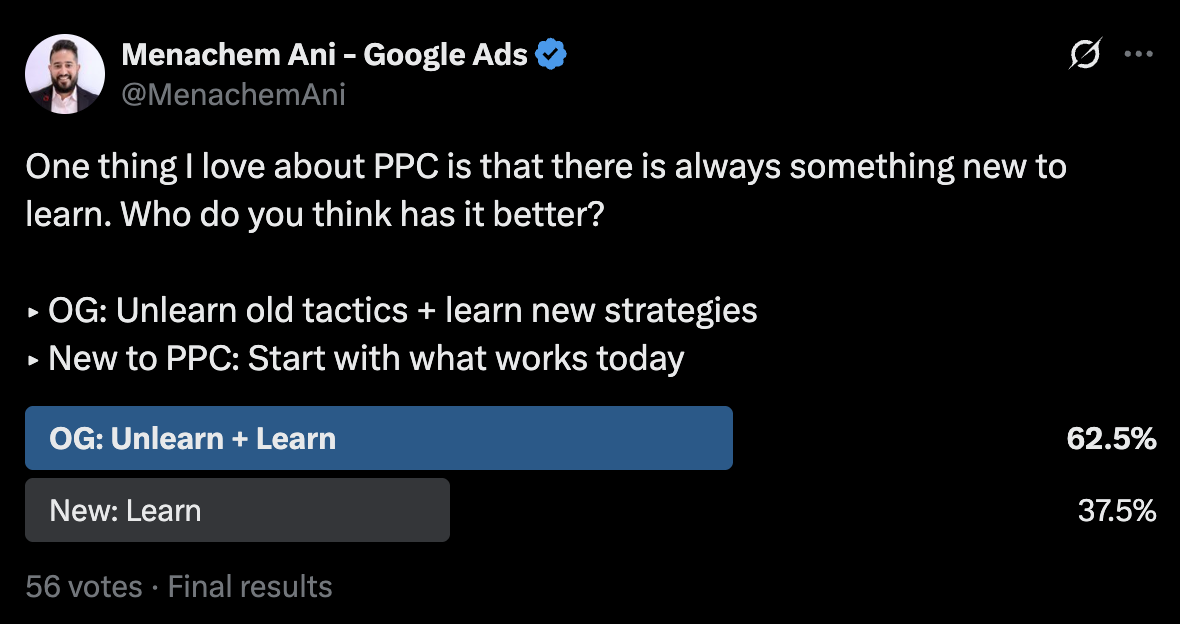
Screenshot from X (Twitter), November 2025
PPC-Adjacent Skills for Performance Max Success
As Google Ads increasingly demands a holistic marketing approach, success with Performance Max often originates outside the ad account itself. With the system handling much of the tactical execution, marketers should focus on upskilling in these crucial areas to secure their future in PPC:
- Develop a deep understanding of fundamental marketing theory that underpins all campaigns, beyond just paid media or Google Ads.
- Understand Google's various automation settings and their functions to react appropriately in any situation.
- Learn how to set up robust online and offline conversion tracking to impact actual business results, not just platform metrics.
- Master the process of setting clear goals for campaigns and clients, ensuring minimal friction and maximum alignment while focusing on execution.
- Acquire comprehensive knowledge of Google's diverse ad inventories and user interaction patterns to adapt strategies across any channel or network.
Why Performance Max Represents the Future
The evolving balance between machine learning and human control in Google Ads signals an imperative: marketers must learn to collaborate effectively with algorithmic campaigns. Performance Max has undergone significant changes since its initial release, reflecting Google's evolving stance. Newer features, such as negative keywords and enhanced reports, offer advertisers more refinement capabilities. However, these tools require judicious use; for instance, removing video ads due to perceived underperformance might be detrimental if their role is to drive conversions further down the funnel.
Today, Performance Max is a viable option for nearly any business type, a stark contrast to its early days when it was primarily limited to large-budget e-commerce and retail. Its viability for a specific business still depends on factors like budget, expertise, risk tolerance, and data availability. Therefore, even if PMax isn't a daily necessity, adapting to this new direction is crucial for safeguarding your business, career, and client relationships in the long term.
Featured Image: Master1305/Shutterstock