
For marketers, a well-defined funnel provides invaluable clarity, allowing us to track customer journeys from discovery to conversion and measure the effectiveness of our strategies. However, in today's AI-first digital landscape, this traditional funnel has largely gone dark, creating a significant measurement gap.
We currently lack comprehensive tools to fully quantify visibility within emerging AI experiences like ChatGPT or Perplexity. While some platforms offer partial insights, their data often falls short in terms of reliability and completeness. Traditional metrics such as impressions and clicks simply don't capture the full picture in these new environments, leaving marketers struggling to understand their brand's presence.
To shed light on this challenge, let's explore the knowns and unknowns of measuring the value of structured data, also known as schema markup. By understanding both what is measurable and what remains elusive, we can strategically focus our efforts today and identify future opportunities as AI continues to reshape how customers discover and engage with brands.
Why Most 'AI Visibility' Data Isn't Real
The rise of AI has fueled a demand for new metrics, leading marketers to seek tools that quantify top-of-funnel activity. However, many emerging platforms are generating novel measurements, such as "brand authority on AI platforms," that lack grounding in representative data.
For instance, some tools attempt to measure AI prompts by equating short keyword phrases with complex consumer queries in ChatGPT or Perplexity. This approach is misleading because actual consumer prompts are often longer, context-rich, nuanced, conversational, and highly personalized—far beyond what traditional keyword-based metrics can capture.
These synthetic metrics offer a false sense of security, diverting attention from what is genuinely measurable and controllable. The reality is that platforms like ChatGPT, Perplexity, and even Google's AI Overviews do not yet provide clear, comprehensive visibility data.
So, what can we measure that truly impacts visibility? Structured data.
What Is AI Search Visibility?
Before delving into metrics, it's crucial to define "AI search visibility." In the context of traditional SEO, visibility typically meant appearing on the first page of search results or earning clicks. In an AI-driven world, visibility evolves to mean being understood, trusted, and referenced by both search engines and AI systems. Structured data plays a pivotal role in this evolution by helping to define, connect, and clarify your brand's digital entities, enabling AI systems to comprehend them effectively.
The Knowns: What We Can Measure With Confidence For Structured Data
Let's examine what is currently known and measurable regarding structured data's impact.
Increased Click-Through Rates From Rich Results
Implementing structured data on a page often qualifies content for a rich result, which consistently leads to increased click-through rates for enterprise brands. Google currently supports over 30 types of rich results, which continue to appear prominently in organic search.
For example, internal data from Q3 2025 shows that one enterprise brand in the home appliances industry experienced a 300% increase in click-through rates on product pages when a rich result was awarded. Rich results continue to deliver significant visibility and conversion gains from organic search.
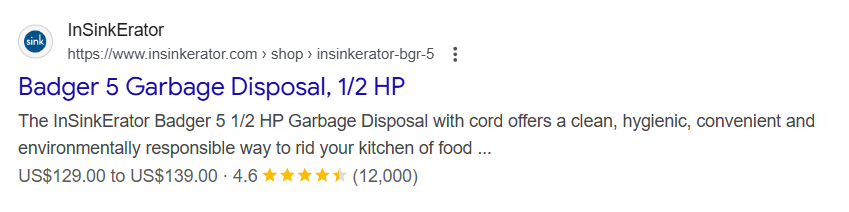
Example of a product rich result on Google’s search engine results page (Screenshot by author, November 2025)
Increased Non-Branded Clicks From Robust Entity Linking
It's important to differentiate between basic schema markup and robust schema markup that incorporates entity linking to build a knowledge graph. While schema markup describes content on a page, entity linking connects those elements to other well-defined entities across your site and the broader web. This process creates relationships that establish deeper meaning and context.
An entity is a unique and distinguishable item or concept, such as a person, product, or service. Entity linking defines how these entities relate to one another, either through external authoritative sources like Wikidata and Google's Knowledge Graph or your own internal content knowledge graph.
Consider a page about a physician: basic schema markup would describe the physician. However, robust, semantic markup would also link to Wikidata and Google's Knowledge Graph to define their specialty, while simultaneously connecting to the hospital and medical services they provide.
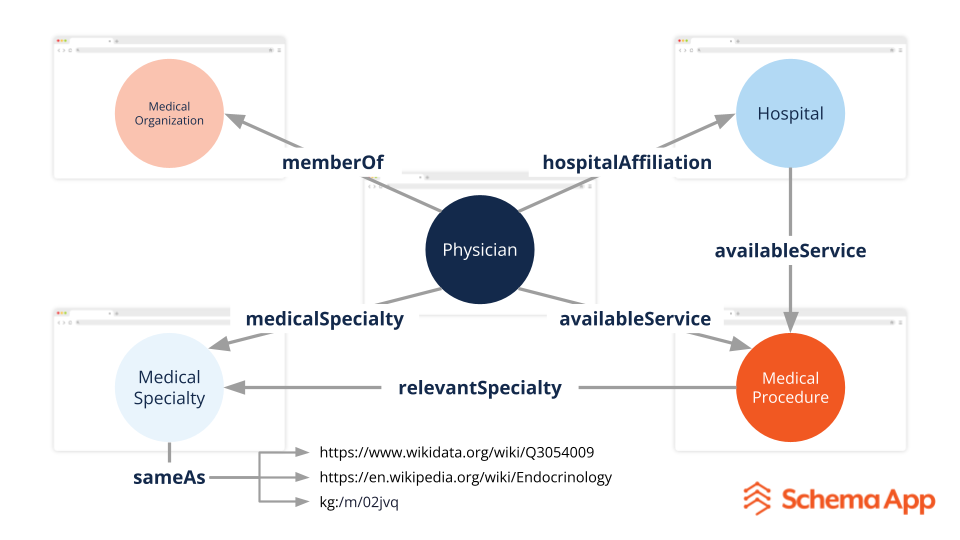
Image from author, November 2025
AI Overview (AIO) Visibility
While traditional SEO metrics cannot directly measure AI experiences, some platforms can identify instances where a brand is mentioned within an AI Overview (AIO) result. Research from a BrightEdge report indicates that adopting entity-based SEO practices significantly enhances AI visibility. The report highlighted:
“AI prioritizes content from known, trusted entities. Stop optimizing for fragmented keywords and start building comprehensive topic authority. Our data shows that authoritative content is three times more likely to be cited in AI responses than narrowly focused pages.”
The Unknowns: What We Can't Yet Measure
Although we can measure the impact of entities in schema markup through existing SEO metrics, we currently lack direct visibility into precisely how these elements influence large language model (LLM) performance.
How LLMs Are Using Schema Markup
Visibility fundamentally begins with understanding, and understanding starts with structured data. Evidence supporting this perspective is growing. In Microsoft's October 8, 2025, blog post, "Optimizing Your Content for Inclusion in AI Search Answers (Microsoft Advertising)," Krishna Madhaven, Principal Product Manager for Microsoft Bing, stated:
“For marketers, the challenge is making sure their content is easy to understand and structured in a way that AI systems can use.”
He further added:
“Schema is a type of code that helps search engines and AI systems understand your content.”
Similarly, Google's article, "Top ways to ensure your content performs well in Google’s AI experiences on Search," reinforces that "structured data is useful for sharing information about your content in a machine-readable way."
Why are both Google and Microsoft emphasizing structured data? One key reason is likely cost and efficiency. Structured data facilitates the construction of knowledge graphs, which serve as the foundation for more accurate, explainable, and trustworthy AI. Research consistently shows that knowledge graphs can significantly reduce hallucinations and improve LLM performance:
- Academic reviews indicate that structured data substantially reduces hallucinations in LLMs.
- NUS + Cambridge (OKGQA 2025) demonstrated that Knowledge Graph grounding reduces hallucinations in open-ended QA benchmarks.
While schema markup itself isn't typically ingested directly to train LLMs, the retrieval phase in retrieval-augmented generation (RAG) systems plays a crucial role in how LLMs respond to queries. Recent work, such as Microsoft's GraphRAG system, generates a knowledge graph (via entity and relation extraction) from textual data and leverages that graph in its retrieval pipeline. In their experiments, GraphRAG often outperforms baseline RAG approaches, particularly for tasks requiring multi-hop reasoning or grounding across disparate entities.
This explains why companies like Google and Microsoft are encouraging enterprise brands to invest in structured data—it acts as the connective tissue that helps AI systems retrieve accurate, contextual information.
Beyond Page-Level SEO: Building Knowledge Graphs
There's a crucial distinction between optimizing a single page for SEO and constructing a comprehensive knowledge graph that connects an entire enterprise's content. In a recent interview, Robby Stein, VP of Product at Google, noted that AI queries can involve dozens of hidden subqueries (known as query fan-out). This suggests a level of complexity that demands a more holistic approach.
To thrive in this environment, brands must move beyond mere page optimization and instead focus on building robust knowledge graphs—or rather, a data layer that represents the full context of their business.
The Semantic Web Vision, Realized
What's truly exciting is that the long-held vision for the semantic web is now becoming a reality. As Tim Berners-Lee, Ora Lassila, and James Hendler articulated in "The Semantic Web" (Scientific American, 2001):
“The Semantic Web will enable machines to comprehend semantic documents and data, and enable software agents roaming from page to page to execute sophisticated tasks for users.”
We are witnessing this unfold today, with transactions and queries occurring directly within AI systems like ChatGPT. Microsoft is already preparing for the next stage, often referred to as the "agentic web." In November 2024, RV Guha—creator of Schema.org and now at Microsoft—announced an open project called NLWeb. The goal of NLWeb is to be "the fastest and easiest way to effectively turn your website into an AI app, allowing users to query the contents of the site by directly using natural language, just like with an AI assistant or Copilot."
In a recent conversation with Guha, he shared that NLWeb's vision is to serve as the endpoint for agents to interact with websites. NLWeb will achieve this by leveraging structured data:
“NLWeb leverages semi-structured formats like Schema.org…to create natural language interfaces usable by both humans and AI agents.”
Turning The Dark Funnel Into An Intelligent One
Just as we currently lack comprehensive metrics for measuring brand performance in ChatGPT and Perplexity, we also don't yet have full metrics for schema markup's precise role in AI visibility. However, we receive clear and consistent signals from both Google and Microsoft that their AI experiences do, in part, utilize structured data to understand content.
The future of marketing belongs to brands that are not only understood but also trusted by machines. Structured data is a fundamental factor in making this future a reality.
More Resources:
- Agentic AI In SEO: AI Agents & The Future Of Content Strategy (Part 3)
- How LLMs Interpret Content: How To Structure Information For AI Search
- How Structured Data Shapes AI Snippets And Extends Your Visibility Quota
Featured Image: Roman Samborskyi/Shutterstock