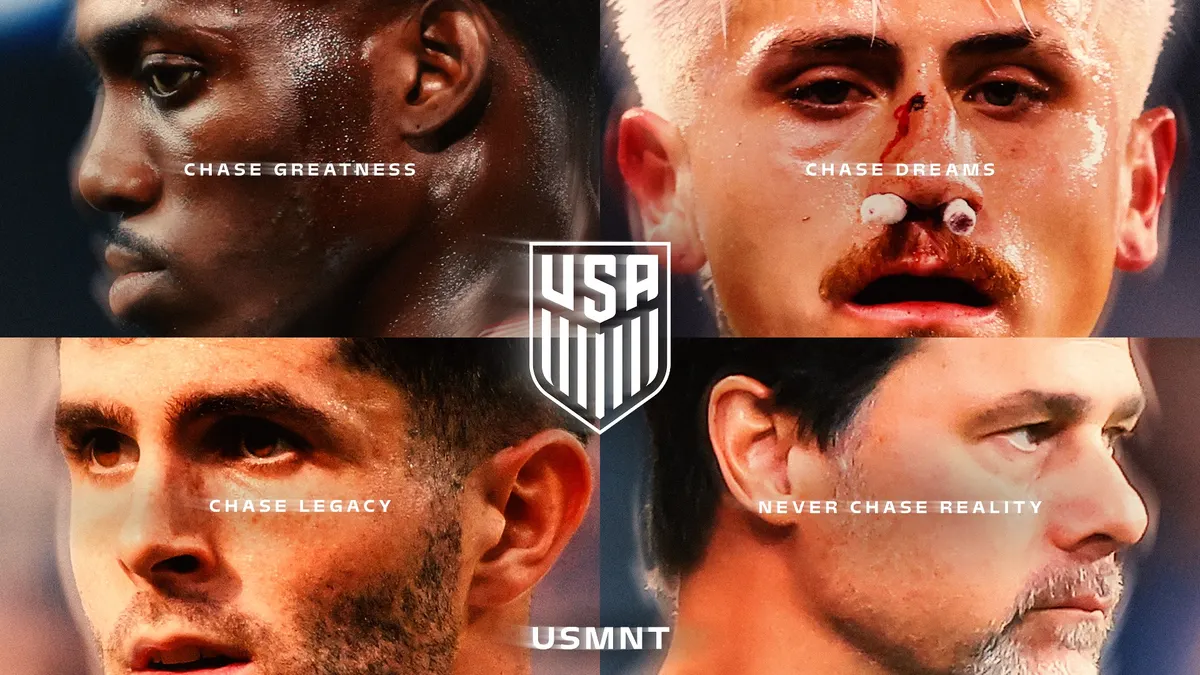
U.S. Soccer has launched a powerful new campaign, “Never Chase Reality,” to rally support for the U.S. Men’s National Team (USMNT) and fans nationwide as the country gears up to co-host the 2026 FIFA World Cup. The campaign, which debuted in early December, strategically coincided with the final draw for the global tournament, marking the first time the U.S. will co-host since 1994.
Anchored by a compelling 90-second video, the “Never Chase Reality” campaign weaves together iconic moments from USMNT history, positioning the team’s pursuit of the World Cup alongside cherished American traditions. Its core tagline encourages players and fans alike to “chase greatness, chase dreams, chase legacy, but never chase reality.”
This major public-facing initiative was developed entirely in-house by U.S. Soccer’s newly established marketing and communications department. The nonprofit organization, which governs American soccer at all levels, aims to deploy the campaign across broadcast, digital, out-of-home, and experiential channels, informed by extensive psychological profiling of U.S. soccer fans.
Driving the Emotional Core of Fan Engagement
Catherine Newman, Chief Marketing and Communications Officer at U.S. Soccer, joined the organization in July 2024 with a clear mandate: to revitalize its marketing function ahead of upcoming Men’s and Women’s World Cups and the 2028 Summer Olympics. These events are expected to generate unprecedented soccer fandom, attracting major marketers such as Unilever, Kellanova, and AB InBev.
Newman elaborated on the campaign’s genesis, emphasizing soccer’s inherent emotional appeal. “Soccer is always about more than the game; it’s always emotional,” she stated. “There’s a saying in the UK that ‘soccer is more than life,’ and I think it translates well for everybody.” The campaign sought to mirror the drive and ambition of the USMNT players and coaching staff, while also acknowledging the sport’s evolving journey in the U.S.
A key aspect of the campaign’s script is its focus on “us,” a term Newman clarifies extends beyond the team to include the “12th man” – the fans. “We wanted to make sure that we created something that recognized the team as a complete circle: the coaching staff, the staff at U.S. Soccer, the men’s team, and then the millions of people who are going to be supporting the team at the tournament,” she explained.
The Power of In-House Creativity
The decision to produce “Never Chase Reality” entirely in-house was a deliberate one, stemming from a strategic reset of U.S. Soccer’s marketing communications function. Newman highlighted the unique advantage of internal teams. “Part of this has been science, and part of this has been creativity, which I think is where the best ads always live: they understand the job that they need to do, but they are data-informed,” she noted.
The creative team benefited from an exceptionally rich brief, bolstered by the content team’s constant proximity to the players. “We travel to Europe with them at times to capture content, but when we’re in camp with them, we are there, 24/7,” Newman said. This intimate access provides insights that no external agency could replicate. While U.S. Soccer partners with M+C Saatchi, the organization felt confident in its internal capabilities to handle such a personal project, entrusted with the players’ and coaching staff’s “thoughts, hopes and dreams.”
Strategic Media and Content Distribution
U.S. Soccer’s media and content strategy for the campaign is multi-faceted, leveraging both owned channels and strategic partnerships. Newman stressed the importance of their internal network: “We obviously have our owned and operated channels, and we will be doing paid as part of this [campaign]. But we also have 118 member organizations and a large fan database.” These loyal supporters, including members, coaches, referees, volunteers, and staff, are considered U.S. Soccer’s “most precious media and distribution channels,” receiving early access to the campaign.
Beyond this core audience, the campaign will feature prominently on broadcast media and even in Times Square. Newman also emphasized the long-term vision for “Never Chase Reality.” “This is also a campaign that is going to live for many months,” she said. “The sentiment encapsulates the journey that we’re on, of which the tournament is one part, but it will very much continue.” The campaign is designed to evolve alongside the team’s journey.
Furthermore, U.S. Soccer is actively building an affiliate network, collaborating with partners like Snap to distribute content. “Snap is one of them, for example. They are now a distribution partner for us, and we work with them in a very different way for our content, and making sure that they have exclusives,” Newman added.
Soccer as a Unifying Force in a Divided Climate
Addressing the challenge of marketing during a politically charged period in the U.S., Newman pointed to U.S. Soccer’s “Soccer Forward” initiative, specifically the “Keeping Score of What Matters” campaign. This initiative champions soccer as a “force for good.”
“Regardless of your politics, a 90-minute game is a great way to spend time with friends and family,” Newman asserted. “It’s good for your mental health, particularly if you’re physically involved, and it gives people an opportunity to come together.” A key psychological insight driving their work revealed that people’s primary reason for loving soccer above other sports was the profound sense of belonging it offered. “We don’t check your status when you come in. That’s not who we are,” she said. “If you want to play, if you want to watch, if you want to commentate, if you want to have a view, then you are very welcome in soccer. The World Cup will be a beautiful and unifying moment that everybody in the country can enjoy.”
Lessons from Sports Entertainment
Before joining U.S. Soccer, Newman served as Executive Vice President of Marketing at WWE. She shared a crucial lesson from her time in sports entertainment: “If I learned nothing else at WWE, it’s that every moment is an opportunity for a story.” She emphasized the power of storytelling and the importance of keeping audiences updated, even when the narrative isn’t what people might expect.
U.S. Soccer is now committed to sharing its journey more openly than ever before. “We’re testing, we’re learning. We’ll make mistakes along the way, but we are hopefully humble enough to understand that we won’t get there by ourselves, that we are a service organization,” Newman explained. She drew a parallel to the “WWE universe,” where everyone has a role to play, a sentiment equally true for U.S. Soccer, encompassing members, partners, donors, fans, and staff. “There are different characters here, for sure. We don’t have anyone body slamming anyone in a meeting, but it’s all good fun,” she quipped.