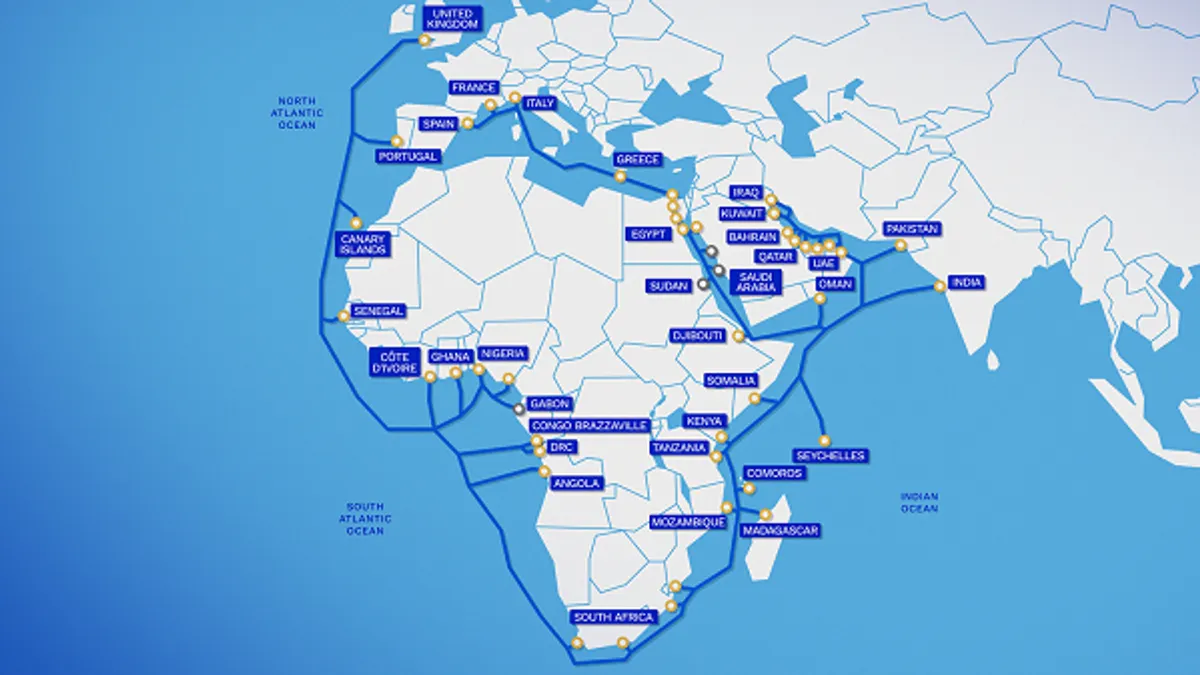
Meta has announced the core completion of its ambitious 2Africa undersea cable project, a significant milestone for global internet connectivity. This update comes despite recent reports of repeated delays, particularly due to security concerns in the Red Sea. The massive digital infrastructure initiative aims to dramatically improve internet access and speed across Africa, Europe, and Asia.
Project Overview and Scope
First announced in 2021, the 2Africa project involves laying 45,000 kilometers of subsea cabling. Its primary goal is to facilitate advanced internet connections between three continents: Africa, Europe, and Asia, specifically targeting key markets in Africa, India, and the Middle East. Meta emphasizes the project's groundbreaking nature, stating:
2Africa is the first cable to connect East and West Africa in a continuous system and link Africa to the Middle East, South Asia, and Europe. With a current reach of 33 countries and still counting, we’re enabling connectivity for 3 billion people across Africa, Europe, and Asia – more than 30% of the world’s population. This scale is unprecedented and we are proud to have partnered with stakeholders across the ecosystem to deliver new levels of connectivity at such scale.
This extensive network is designed to significantly improve connectivity and digital access across these regions.
Technological Innovations
The development of the 2Africa cable required innovative engineering solutions. Meta reports increasing the cable's burial depth by 50% compared to previous systems. This enhancement is designed to improve resilience and network availability by avoiding seabed hazards such as seamounts and hot brine pools.
Challenges and Geopolitical Tensions
Despite this progress, the 2Africa project has faced significant geopolitical challenges, particularly in the Red Sea region. Reports from Bloomberg indicate that construction teams have been repeatedly subjected to missile attacks, allegedly carried out by the Iranian-backed Houthi armed group. These security risks, coupled with political tensions and border disputes, have caused considerable delays and necessitated re-routing sections of the cable. Google has also encountered similar issues with its own undersea cabling initiatives in the region. Meta's careful phrasing of the announcement, emphasizing the completion of the "core" system rather than the entire planned construction, tacitly acknowledges these ongoing challenges.
Economic Impact and Future Potential
Nevertheless, Meta remains confident in 2Africa's transformative potential. The company projects that the cable will deliver a "step change" in international bandwidth for Africa, ensuring greater connectivity for the emerging region. Meta further elaborates on its capacity:
For example, on the West segment, stretching from England to South Africa, and landing in countries such as Senegal, Ghana, Cote d’Ivoire, Nigeria, Gabon, the Republic of Congo, DRC, and Angola, the cable supports 21 terabits per second (Tbps) per fiber pair, with 8 fiber pairs on the trunk. This results in a total trunk capacity of up to 180 Tbps. This massive capacity ensures a near-limitless supply of international internet bandwidth, allowing internet service providers (ISPs) and mobile network operators (MNOs) to secure capacity at much lower wholesale prices.
Economically, 2Africa is projected to contribute up to $36.9 billion to Africa's GDP within its first two to three years of operation. For Meta, this enhanced infrastructure will also enable broader opportunities for deploying its AI tools and maximizing revenue potential in more markets worldwide.