Snapchat has released its Q3 2025 performance update, revealing robust revenue and continued user growth, yet signaling significant challenges ahead. While the platform saw increases in daily active users (DAU) and monthly active users (MAU), the company grapples with persistently rising costs, stalled growth in crucial markets, and the uncertain future of its augmented reality (AR) Spectacles.
User Growth and Regional Stagnation
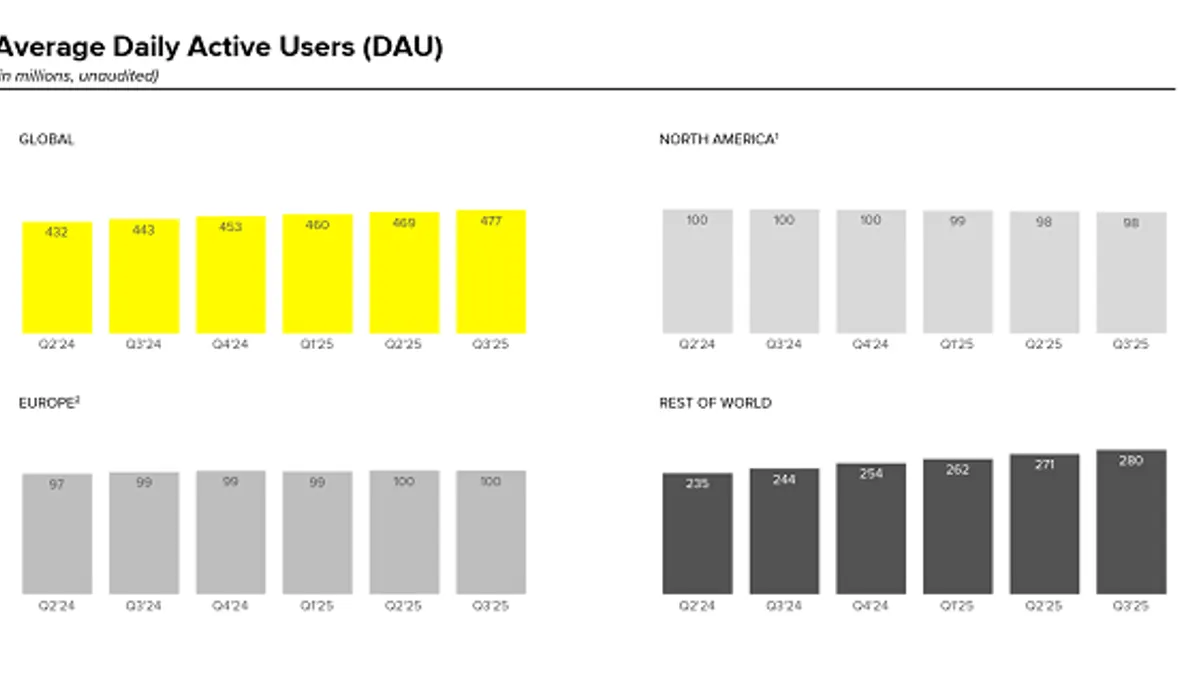
The platform reached 477 million daily active users in Q3 2025, an increase of 8 million from the previous quarter. Monthly active users are now nearing the one-billion mark, standing at 943 million. However, this growth is almost entirely concentrated in the "Rest of World" category, with user acquisition in the U.S. and Europe appearing to have stalled, suggesting market saturation in these key regions.
This regional stagnation is compounded by increasing discussions around higher age restrictions for social media use. Snapchat acknowledges this concern, stating in its accompanying notes:
"These policy developments, combined with potential platform-level age verification, are likely to have negative impacts on user engagement metrics that we cannot currently predict."
The company is exploring new signals from Apple and Google for age determination, a move that could significantly impact platform usage and monetization potential, particularly in markets where user growth has already plateaued.
Revenue Performance and Strategic Reassessment
Despite user growth challenges in core markets, Snapchat's revenue performance remains strong. The company generated $1.5 billion in revenue for the quarter, attributing this success to:
"Continued growth in our small- and medium-sized business (SMBs) customers, and improvements in direct response advertising performance."
Efforts to enhance ad targeting tools and placement options are evidently paying off, attracting more advertisers keen on reaching Snapchat's young audience. Additionally, Snapchat+ subscriptions now contribute an impressive $750 million annually.
To optimize its financial opportunities, Snap is reassessing its business approach, prioritizing key revenue markets. This involves strategic infrastructure changes to lower costs in regions with less long-term monetization potential. The company notes:
"This includes testing changes to our infrastructure that will lower costs in regions with less long-term monetization potential, allowing us to better align our resources with the financial opportunity of each geography, but potentially coming at the cost of adverse trade-offs with engagement in these countries."
This acknowledges that while top-line user growth is positive, revenue generation varies significantly by region, necessitating a more focused allocation of resources.
Engagement and Content Innovation
Global time spent watching content on Snapchat has increased year-over-year, driven by multi-year investments in machine learning and the continued strength of its short-form video feature, Spotlight. Snap has launched its largest content recommendation model to date, enhancing "freshness and relevance across the platform." Infrastructure upgrades have also reduced model training cycles from days to just two hours, aiming for near real-time content delivery.
Spotlight, in particular, has seen remarkable success, with views in the U.S. surging over 300% year-over-year, mirroring the widespread popularity of short-form video across social platforms. Further bolstering engagement, Snapchat announced a new partnership with Perplexity, integrating its AI-powered answer engine directly into the app. This move aims to offer more opportunities for user interaction and maximize audience potential.
The AR Spectacles Dilemma
A significant concern remains Snapchat's persistently rising costs, which are set to escalate further with the planned launch of its AR-enabled Spectacles next year. The market for AR glasses is becoming increasingly competitive, with Meta's AI glasses already offering advanced functionality and both Meta and Apple poised to launch their own AR devices soon. This competitive landscape casts doubt on the market opportunity for Snap's Spectacles.
Recognizing the potential financial burden, Snap has reportedly considered spinning off Spectacles into a separate business to mitigate its impact on the core company. While a complex approach, this strategy could protect Snap's valuation, especially given that the company lacks the robust advertising business of its larger competitors to absorb potential losses from a lukewarm product launch. The initial hype around its original Spectacles in 2016, which ultimately led to unsold inventory and financial losses for Snap, serves as a cautionary tale. The success of the new AR Spectacles remains to be seen in the coming months.