Snap Inc. recently released its Q4 2025 performance update, revealing an anticipated decline in daily active users (DAU) despite a steady rise in revenue. These figures are particularly significant as Snap approaches a critical period for its future, marked by the upcoming launch of its augmented reality (AR) Spectacles.
Daily Active User Decline and External Factors
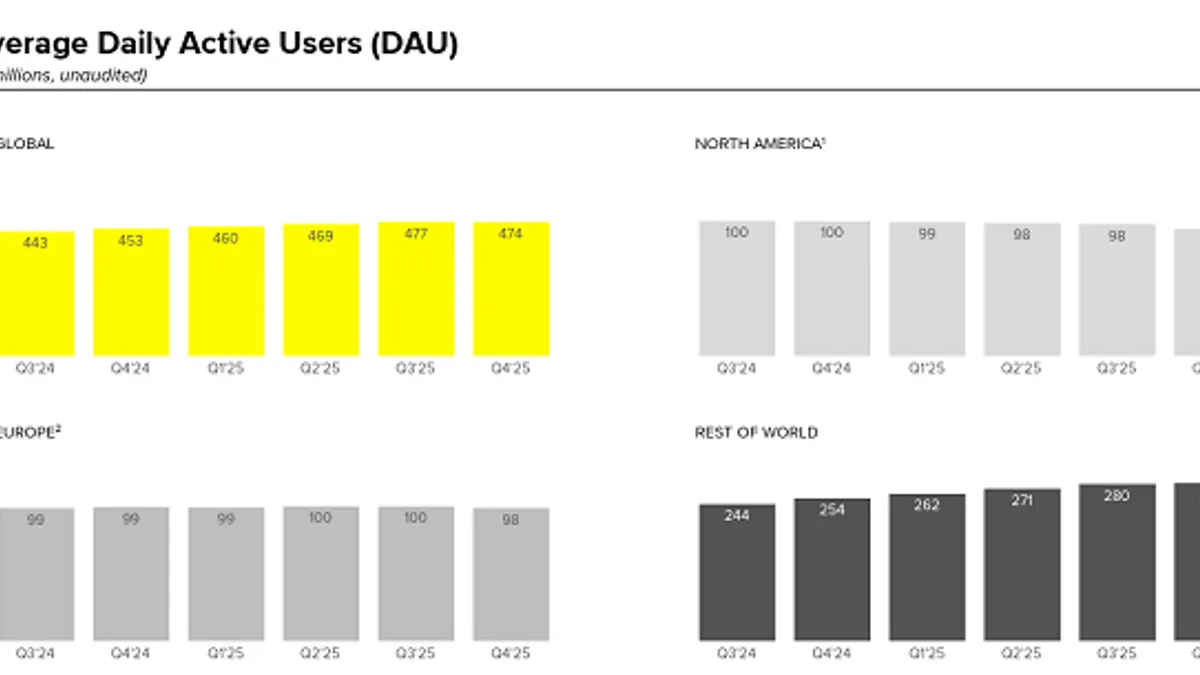
Snapchat reported a loss of 3 million daily active users compared to Q3 2025, bringing its total DAU to 474 million. This decline was not entirely unexpected, largely due to external geopolitical and regulatory challenges.
In early December, Snapchat was banned in Russia as part of the government's push for domestic social media adoption. Shortly after, the platform lost a significant number of users in Australia following new government restrictions for users under 16. Cumulatively, these actions are estimated to have resulted in a loss of approximately 8.5 million users within weeks, through no fault of Snap Inc. Given these circumstances, the 3 million DAU decline suggests that Snapchat has managed to maintain engagement relatively well.
However, the report also indicates a concerning trend: Snapchat is losing users in key revenue markets like the U.S. and the EU. This consistent decline suggests the app may be reaching a saturation point in these regions, potentially necessitating a greater reliance on advertising to boost revenue.
Revenue Growth and Strategic Shifts
Despite the user challenges, Snapchat reported strong financial performance, bringing in $1.72 billion for the quarter, a 10% increase year-over-year. This growth indicates that the company's current revenue strategies are effective, at least for now.
Snap Inc. remains heavily dependent on the U.S. market for its revenue. While the "Rest of World" category shows expanded opportunities, the average revenue per user has not significantly shifted year-over-year to fully capitalize on this potential.
In its letter to shareholders, Snap outlined its focus on diversifying revenue and driving "more profitable growth." The company detailed three core initiatives for its advertising business:
- Fostering direct connections between brands and Snapchatters using core product capabilities.
- Enhancing advertiser effectiveness through AI tooling and capabilities across its ad platform, covering creative development, campaign setup, and performance optimization.
- Expanding its advertiser base by scaling and optimizing go-to-market operations for small and medium-sized businesses (SMBs).
SMBs have been a significant contributor to revenue growth. Additionally, non-advertising projects, such as Snapchat+ subscriptions and expanded Memories storage, have also boosted intake.
“In the year ahead, we will focus on growing existing subscription offers, while innovating to bring compelling new offers to our platform. This momentum is already materializing, with subscribers growing 71% year-over-year to reach 24 million in Q4. In the year ahead, growth in subscribers will be a critical input metric to track our progress, and we will ultimately grade our performance based on growth of the annualized run rate for Other Revenue.”
This statement highlights Snap's strategic shift towards maximizing revenue from its existing audience rather than solely focusing on user growth. While this approach carries risks—such as potential user alienation from an increase in ads or the historical challenge of social media apps generating substantial revenue from subscriptions—it appears to be a necessary pivot given the declining user numbers.
Interestingly, while daily active users have decreased, monthly active users (MAU) continue to grow. This suggests a potential shift in how users engage with the app, perhaps viewing it more as an entertainment platform than a daily messaging utility.
The Looming Challenge: AR Specs Launch
The most significant challenge for Snap Inc. lies ahead with the impending launch of its AR Spectacles. Snapchat has been a pioneer in AR engagement and viral AR activations for years, predating efforts from competitors like Meta and Apple.
While Snap's early entry and expertise in AR provide some market advantages, competing against the vast resources of Meta, which already holds a position in the smart glasses market, will be formidable. There's skepticism regarding the competitiveness of Snap's AR Specs, with some analysts suggesting they may be heavier, less functional, and less valuable than Meta's upcoming AR device, slated for consumer launch next year. Although Snap might gain a first-mover advantage, overcoming Meta's capabilities in this space is seen as a significant hurdle.
Snap has strategically separated its Spectacles unit into its own business, likely to shield its core operations from potential losses should the AR glasses not perform as expected. However, the company must carefully manage its investment in a device that faces intense competition.
“We believe Snap is uniquely positioned to lead the next wave of spatial computing. With Snap OS 2.0, Lens Studio, Snap Cloud, and a global developer ecosystem, we have built an end-to-end AR platform spanning software, tools, and hardware. Together, these capabilities position us to deliver fully standalone, human-centered eyewear that expands creative expression and unlocks new ways for people to engage with the world around them.”
Snap's true strength may lie in its comprehensive AR platform rather than the hardware itself. The arrival of Meta's AR glasses, coupled with the historical rivalry between Mark Zuckerberg and Snap CEO Evan Spiegel (stemming from Snap's rejection of Meta's takeover offer years ago), suggests that Meta will likely aggressively counter any enthusiasm around Snap's AR Specs.
Outlook
Overall, Snap's Q4 2025 report reflects a company navigating significant challenges with a mixed performance. The coming year will be a crucial test for Snap as a business and for Evan Spiegel's leadership. The company faces the delicate task of balancing increased advertising and subscription monetization with user experience, aiming to alleviate market concerns about its shrinking daily user base while preparing for a highly competitive AR hardware market.