Meta's independent Oversight Board has released a new report commemorating its five-year anniversary, detailing its significant role in shaping the company's content moderation policies. Established as a bold experiment in external oversight, the Board has provided objective assessments that have influenced Meta's approach to complex content decisions, moving beyond internal directives and ensuring broader consideration for its billions of users.
The Oversight Board was initially conceived as an experiment to demonstrate how independent, third-party input could enhance policy decisions, thereby decentralizing power from a small group of Meta executives. Its mandate was to bring expert insight and a wider perspective to the impacts of Meta's processes, ensuring more robust and equitable digital governance.
Over its five years, the Board has proven successful, prompting significant shifts in Meta's policy approaches. According to its anniversary report, the Board has made substantial progress for Meta's global users, introducing transparency, clear reasoning, and a crucial human rights perspective to decisions previously made behind closed doors with little public justification.
“Five years on, the Board has made important strides for Meta’s global users, bringing transparency, reasoning and a human rights perspective to decisions that were long made behind closed doors, and with little or no public-facing rationale. The model we have built brings experts from around the globe to independently review sensitive content decisions on Meta platforms with input from the public and civil society. Our Board Members are politically, ideologically, geographically, culturally and professionally diverse. This means we can take better account of the varied contexts affecting speech and other human rights in different parts of the world.”
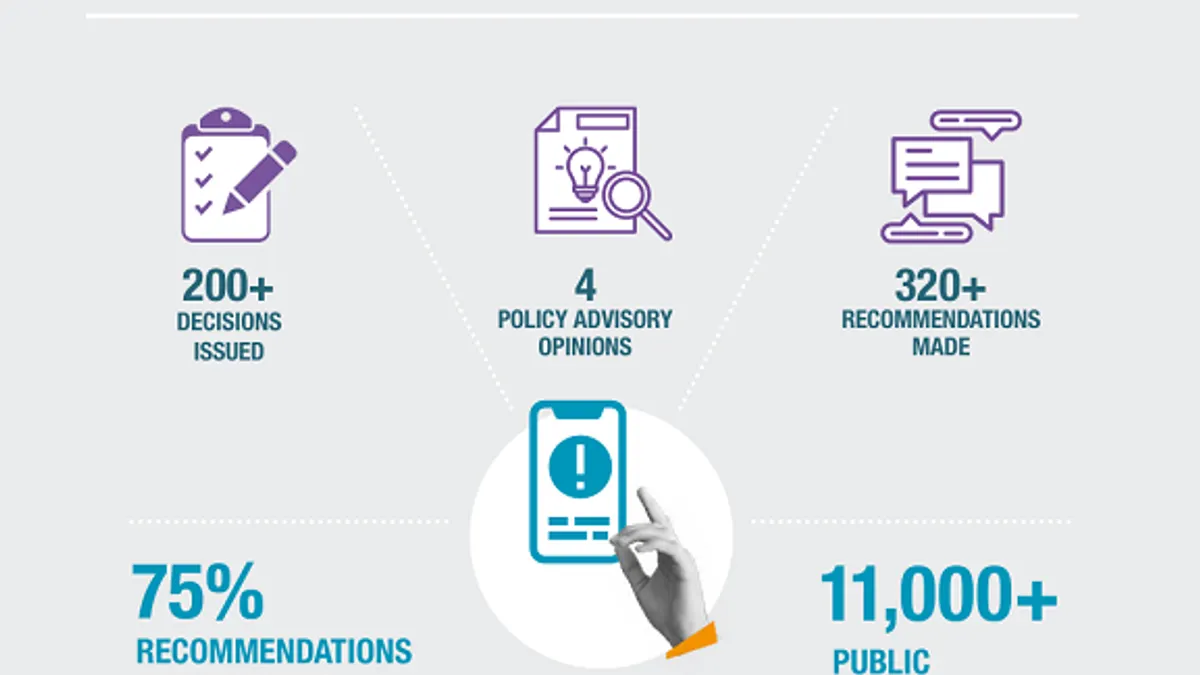
Reinforcing its value, Meta has implemented 75% of the more than 300 recommendations issued by the Oversight Board. While questions naturally arise about the true independence of a board appointed and funded by Meta, it has largely managed to operate in isolation from the company's direct governance, providing an essential layer of checks and balances.
The Oversight Board was always envisioned as a pilot for a much larger concept: a global, multi-platform oversight commission. Following various content moderation controversies, Meta itself had called for external governance to establish definitive rules for social platforms, aiming to lessen the burden on individual companies and mitigate biases inherent in corporate leadership. The Board was designed to illustrate how such a collaborative, independent body could function, overseeing all social platforms and eliminating concerns of corporate favoritism or political bias in rulings.
However, this broader vision remains unfulfilled. No such global body has yet been formed, and governments worldwide continue to pressure social platforms to censor information based on their own national interests. This fragmented approach is far from optimal. With diverse and often conflicting ideas about content moderation and the appropriate level of government involvement, achieving a consensus for a unified global oversight mechanism appears increasingly challenging.
Despite these hurdles, Meta’s Oversight Board demonstrates that effective external oversight is achievable and can significantly impact critical policies across platforms reaching billions. In an era where leaders increasingly seek to control media narratives and with the rise of complex AI-generated content muddying the waters, the need for independent oversight is more critical than ever. Yet, the consensus required to establish a global social media oversight group remains elusive.
This means individual platforms are largely left to navigate these complex issues alone, making decisions based on internal assessments and bottom-line considerations. While centralized governance, as exemplified by the Oversight Board, offers a more functional and workable process, broad international agreement on its implementation continues to be an uphill battle.
You can read the full summary report of the Oversight Board’s impact here.