Meta has released its latest transparency reports, including the Community Standards Enforcement Report and the Widely Viewed Content Report. These updates offer insights into the company's content moderation efforts, the impact of its shift to a Community Notes model, and data on fake accounts and popular content across Facebook and Instagram.
Meta Reports on Content Moderation and Community Notes
Meta asserts that its transition to a Community Notes model, which began in January and replaced its third-party fact-checking process, is proving effective. This move, inspired by platforms like X (formerly Twitter), was intended to give users more input into content decisions, reducing perceived "heavy-handed" censorship.
According to Meta's Q3 Community Standards Enforcement Report, less than 1% of the hundreds of billions of content pieces produced globally on Facebook and Instagram were removed for policy violations. Furthermore, less than 0.1% of content was removed incorrectly. Meta reported an "enforcement precision" – the percentage of correct removals out of all removals – of over 90% on Facebook and more than 87% on Instagram.
While Meta highlights these figures as a win, suggesting fewer mistakes and user complaints, the report also acknowledges that if overall content removal decreases, the number of mistakes might naturally appear lower. Quantifying the precise success of Community Notes as an alternative to systematic enforcement, based solely on user complaints or removal precision, remains challenging.
Prevalence of Harmful Content
The report indicates an increase in the prevalence of adult nudity and sexual activity, as well as violent and graphic content, on both Facebook and Instagram. On Facebook specifically, bullying and harassment also saw an increase. Meta attributes these spikes primarily to internal changes made during the quarter, including improved reviewer training and enhanced review workflows. These methodological adjustments impact how samples are labeled when measuring prevalence, making it difficult to definitively assess whether these increases represent actual content shifts or merely better detection.
Fake Accounts on Meta Platforms
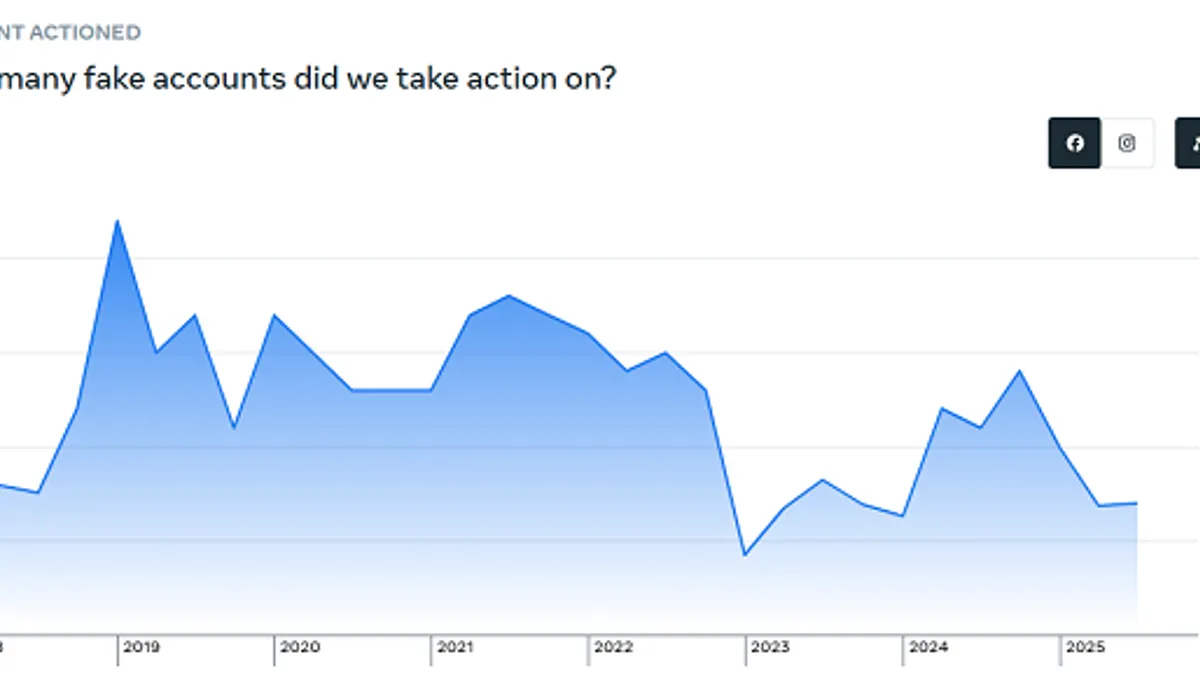
Meta maintains that approximately 4% of its more than 3 billion monthly active users are fake accounts. For context, this translates to over 140 million fake profiles across its apps, a figure Meta officially acknowledges. This estimate has often been questioned by users based on their personal experiences with fake profiles on Facebook and Instagram.
The definition of a "fake account" is further complicated by Meta's ongoing projects to integrate AI profiles into its apps, designed to interact like real people. This raises questions about whether these AI-driven entities will be classified as "fake" in future reports.
The Widely Viewed Content Report: What Users See
Meta also published an update to its "Widely Viewed Content Report" for the U.S., a report originally launched in 2021. The report's primary goal is to dispel the notion that Facebook's algorithms amplify divisive content and misinformation by showcasing the types of posts and Pages that garner the most engagement.
The Q3 report suggests that trending news stories are what Facebook users are most interested in. Examples of top-performing content included crime stories, celebrity news (such as the death of actor Julian McMahon), and human-interest stories (like the Coldplay concert couple). This indicates a shift from typical tabloid gossip, with Meta emphasizing that political content is not a major element of discussion in the app's most viewed content. However, given Facebook's immense scale, even content with relatively small traction can still reach millions of people, making the platform's overall influence significant.
Decline of Link Posts
A notable finding for digital marketers is the continued decline in the prevalence of link posts. The report shows that link posts now constitute a tiny fraction of overall content on Facebook. Their prevalence has decreased significantly from 9.8% in 2022 to 2.7% in Q1, and an even smaller percentage in Q3. This trend suggests that Facebook is becoming less effective for driving external traffic, potentially disappointing those looking to leverage the platform for website referrals.
Conclusion
Overall, Meta's latest transparency reports present a nuanced picture. While the company highlights improved precision in content moderation and the perceived success of its Community Notes initiative, the data also suggests potential for increased exposure to harmful content (attributed to methodological changes) and a substantial number of fake accounts. The reports further reinforce that trending news dominates user interest, while the effectiveness of link posts for driving external traffic continues its downward trend.