

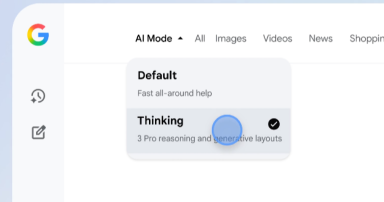
Google has officially rolled out its most advanced large language model, Gemini 3, into Search's AI Mode, marking a significant upgrade to how users interact with search results. This integration introduces deeper reasoning capabilities, enhanced query processing, and dynamic generative layouts, promising a more intelligent and interactive search experience. Notably, this is the first time Google has deployed a new Gemini model into Search on its initial release date.
Currently, Google AI Pro and Ultra subscribers in the U.S. can access the Gemini 3 Pro model by selecting the "Thinking" option within AI Mode. Google has stated plans to soon expand Gemini 3 access to all U.S. users, with Pro and Ultra subscribers retaining higher usage limits.
What's New: A Smarter Search Experience
The integration of Gemini 3 brings a suite of powerful enhancements designed to transform the AI Mode experience. Robby Stein, VP and GM of Google Search, highlighted the model's capabilities on X (formerly Twitter):
“Gemini 3, our most intelligent model, is landing in Google Search today — starting with AI Mode. Excited that this is the first time we’re shipping a new Gemini model in Search on day one!”
Search Updates and Generative Layouts
Google describes Gemini 3 as possessing state-of-the-art reasoning and deep multimodal understanding. Within Search, it is engineered to explain complex concepts, tackle intricate questions, and support interactive visuals directly within AI Mode responses. With Gemini 3, Google asserts that AI Mode has fundamentally re-architected the concept of a "helpful response."
Stein further elaborated on this, explaining:
“Gemini 3 is also making Search smarter by re-architecting what a helpful response looks like. With new generative UI capabilities, Gemini 3 in AI Mode can now dynamically create the overall response layout when it responds to your query — completely on the fly.”
This means that instead of merely presenting a block of text, AI Mode can now design a response layout specifically tailored to the user's query. This includes intelligently deciding when to incorporate images, tables, or other structured elements to make the answer clearer and more actionable.
In the coming weeks, Google will introduce automatic model selection, as Stein noted:
“Search will intelligently route tough questions in AI Mode and AI Overviews to our frontier model, while continuing to use faster models for simpler tasks.”
Enhanced Query Fan-Out
A significant upgrade comes in the form of Gemini 3's enhanced query fan-out technique. According to Stein, Google Search can now execute more related searches concurrently and better interpret a user's underlying intent. This improvement could lead to Google discovering and surfacing content it might have previously missed. Stein added:
“It now performs more and much smarter searches because Gemini 3 better understands you. That means Search can now surface even more relevant web content for your specific question.”
Dynamic Generative UI
Gemini 3 in AI Mode introduces advanced generative UI features that construct dynamic visual layouts based on your query. The model intelligently analyzes your question and builds a customized response using a variety of visual elements, such as images, tables, and grids. For situations where an interactive tool would be beneficial, Gemini 3 can even generate a small, real-time application and embed it directly into the answer.
Examples provided by Google include:
- An interactive physics simulation for exploring the three-body problem.
- A custom mortgage loan calculator that allows users to compare different options and estimate long-term savings.
Crucially, all these responses feature prominent links to high-quality content across the web, enabling users to easily navigate to the original source material. A demonstration of these capabilities is available in Google’s official launch video.
Why This Matters for Content Publishers
The rollout of Gemini 3 significantly alters how content may be discovered and utilized within AI Mode. With its deeper query fan-out capabilities, Google can now access a greater number of web pages per question, potentially influencing which sites are cited or linked during extensive, complex searches. Furthermore, the updated layouts and interactive features will change how links appear on users' screens. On-page tools, explainers, and visualizations generated by AI could now directly compete with Google’s traditional interface elements. As Gemini 3 becomes more widely available, it will be crucial for content creators and publishers to monitor how their content is presented or referenced in AI responses, in addition to conventional search rankings.
Looking Ahead
Google has indicated that it will continue to refine these updates based on user feedback as more individuals begin to utilize the new tools. Automatic model selection is slated for release in the coming weeks for Google AI Pro and Ultra subscribers in the U.S., with a broader U.S. rollout of Gemini 3 in AI Mode planned, though a specific schedule has not yet been announced.


