Automattic, the for-profit company co-founded by WordPress creator Matt Mullenweg, has sent a trademark complaint letter to WordPress developer Kevin Geary. The letter demands that Geary rebrand his WordPress CSS framework, currently named Automatic.css, arguing that its similarity to "Automattic" could lead to consumer confusion.
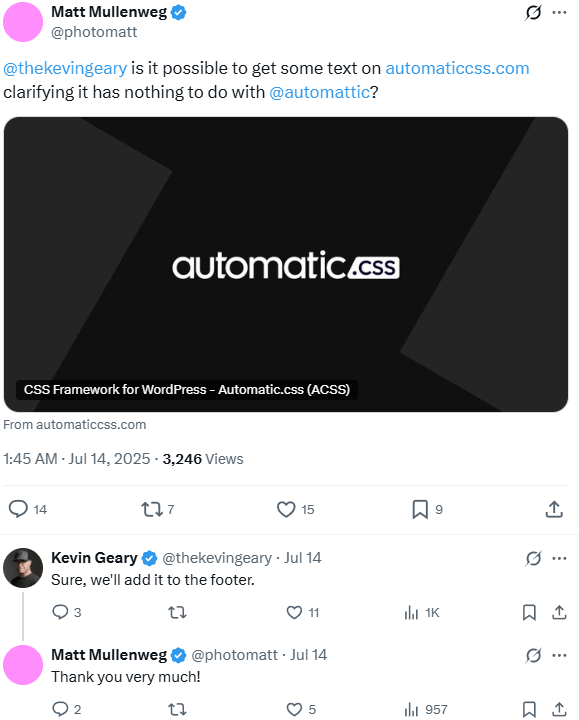
This legal action has surprised many within the WordPress industry. Geary had previously shown good-faith compliance months ago when Mullenweg publicly requested him to add a disclaimer to the footer of Automatic.css.
Mullenweg's July 2025 Tweet to Geary
Who is Kevin Geary?
Kevin Geary has been a well-regarded and popular member of the WordPress developer community since 2005. He is currently developing a WordPress page builder called EtchWP (in its Alpha stage) and is the creator of the widely acclaimed CSS framework, Automatic CSS (ACSS). ACSS is designed to simplify design consistency within websites, seamlessly integrating with popular page builders like Bricks, Gutenberg, and Oxygen, which are widely used in the web design community.
A year ago, Geary garnered significant attention for a YouTube video and accompanying article where he documented his attempt to use WordPress’s native Block Editor. His experience resulted in a comprehensive list of issues he believed needed urgent fixing.
Regarding the Gutenberg workflow, he wrote:
“Is this the ‘for everyone’ experience? Is this the true vision of the WordPress block editor? …it’s wildly inefficient and impractical.”
He also noted widespread confusion about Gutenberg’s intended purpose, citing an informal poll of his Twitter followers that showed disagreement on whether it should be considered a page builder.
He concluded:
“It’s NOT for:
- Beginner web developers who want to learn how to build websites.
- Intermediate web developers who want to build custom websites.
- Advanced web developers who want to build custom websites.
- Most agencies & freelancers (unless they’re committed to building custom blocks).
I want to like it, I really do. As it stands now, though, the only viable way to use the block editor to build a custom site is with third-party tools. Native ain’t cutting it.”
These criticisms highlight Geary’s passion for WordPress, even when he points out flaws in core components like the block editor or the "tragedy of the commons" support model underlying the platform.
Automattic's Letter to Geary
Geary tweeted a copy of the letter from Mullenweg’s lawyers, which requested the rebranding of his WordPress CSS framework.
An excerpt from the letter stated:
“We represent Automattic Inc. in intellectual property matters. As you know, our client owns and operates a wide range of software brands and services, including the very popular web building and hosting platform WordPress.com. Automattic is also well-known for its longtime and extensive contributions to the WordPress system.
Our client owns many trademark registrations for its Automattic mark covering those types of services and software. As a result of our client’s extensive marketing efforts and support of the WordPress system, consumers have come to closely associate Automattic with WordPress and its related offerings.
We are writing about your use of the name and mark Automatic (sometimes with a CSS or .CSS suffix) to provide a CSS framework specifically designed for WordPress page builders. As we hope you can appreciate, our client is concerned about your use of a nearly identical name and trademark to provide closely related WordPress services. Automattic and Automatic differ by only one letter, are phonetically identical, and are marketed to many of the same people. This all enhances the potential for consumer confusion and dilution of our client’s Automattic mark.
We assume you share Automattic’s interest in ensuring that consumers are not confused or misled by the use of nearly identical names and trademarks to provide related services in the WordPress ecosystem. To protect against any such confusion or dilution, Automattic requests that you rebrand away from using Automatic or anything similar to Automattic. I suggest that we schedule a time to discuss the logistics and a mutually agreeable transition timeline for the change. Please let me know some days and times when you are available.”
Matt Mullenweg responded to Geary’s tweet by claiming to "own" the automatic.com domain. However, domain names are registered, not owned outright.
Mullenweg’s tweet read:
“We also own http://automatic.com. You had to know this was a fraught naming area.”
To which Geary responded:
“AutomaticCSS is called ‘automatic’ because it’s the only CSS framework that does a lot of things automatically.
Congratulations on owning the domain name for a generic term. Let me know when that fact becomes relevant.”
Social Response to Automattic's Letter
Most responses to Geary’s tweet were supportive, though one user questioned Geary’s choice of the word "Automatic." Tweeting:
“Why go with ‘AutomaticCSS’ as the name though?
Options like ‘AutoCSS’ or even ‘AutomatedCSS’ would have been even more suitable IMHO.
It could indeed raise the question of whether there was some other motive at play. Just sharing my thoughts!”
This tweet was an outlier, with the majority of reactions expressing support for Geary.
Simon Zeimke tweeted:
“A letter from hell. How could a generic Term be IP?”
Lee Milroy responded:
“This is absurd, a product that has been around for 4 years is all of a sudden going to create ‘confusion’?
Really Matt needs to do some work… like the terrible WP Dashboard experience”
WordPress Drama
Over a week has passed since the letter was sent, and Geary has not yet publicly announced his next steps. Many in the WordPress community would likely prefer to see this dispute resolved quickly, allowing everyone to refocus on improving the WordPress ecosystem.